
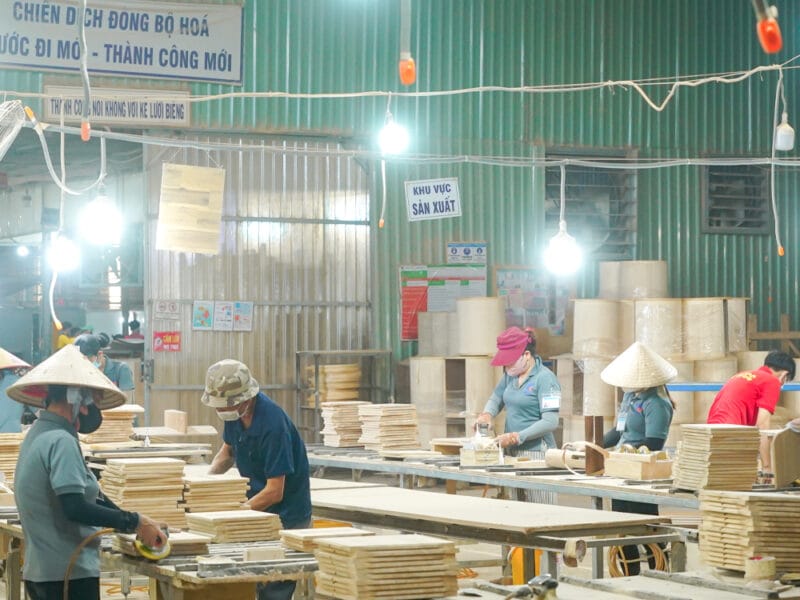
Sourcing Wooden Furniture from Vietnam for the UK: A Buyer’s Guide
Finding a wood furniture manufacturer in Vietnam is relatively easy. Finding a manufacturer whose product capability, engineering support, quality control, materials, packaging, and production process match your retail program requires a more detailed evaluation.
For UK furniture retailers, importers, wholesalers, and brands, the sourcing process should therefore go beyond comparing factory profiles and FOB prices.
Buyers need to understand what a factory actually manufactures, how product specifications are controlled, how prototypes are evaluated, what happens during quality inspection, and whether packaging has been considered as part of product development.
IMITI Company Limited is a Vietnam-based wooden furniture manufacturer with over 10 years of manufacturing experience, supporting international B2B buyers with wooden bedroom furniture, wooden living room furniture, and other custom OEM/ODM wooden furniture.
This guide explains some of the practical areas UK buyers should consider when sourcing wooden furniture from Vietnam.
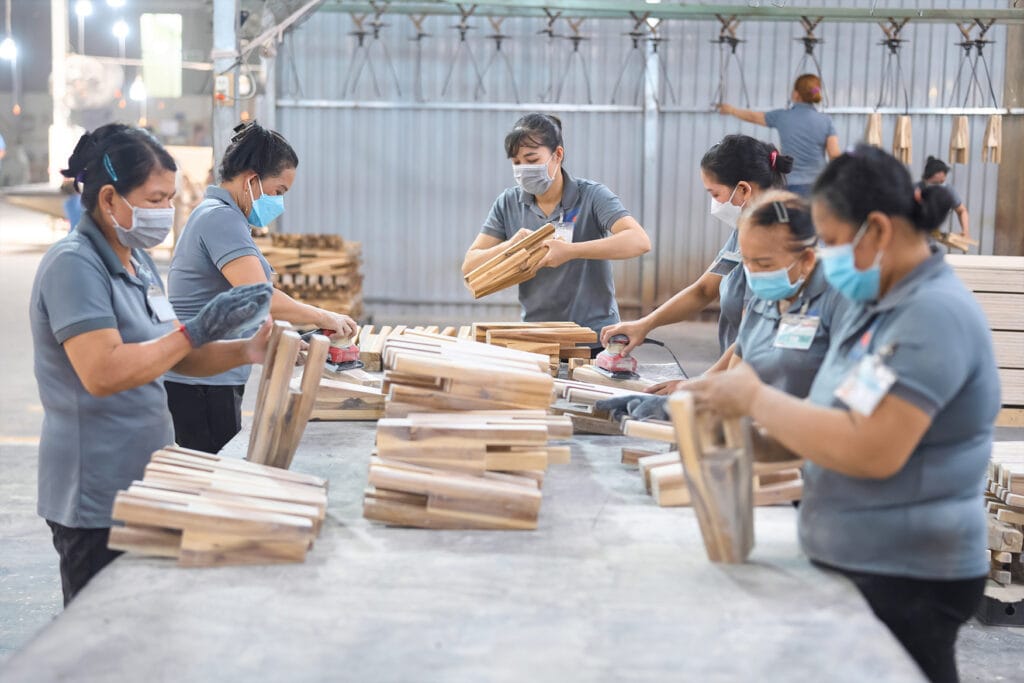
Start With the Product, Not the Factory Size
A common starting point in furniture sourcing is to compare factories based on production capacity, factory area, workforce, or price.
Those factors matter, but they do not necessarily tell a buyer whether a factory is suitable for a particular furniture collection.
The first question should be:
Does this manufacturer have relevant experience with the type of furniture we want to develop?
For example, a buyer developing wooden bedroom and living room collections should consider whether the manufacturer regularly works with similar materials, constructions, finishes, hardware, assembly methods, and packaging requirements.
At IMITI, our core focus is wooden and wood-based furniture manufacturing.
Our product capabilities include:
- Wooden bed frames
- Nightstands and bedside tables
- Dressers and chests
- Bedroom collections
- Coffee tables
- Side tables and end tables
- TV stands and media units
- Console tables
- Wooden benches
- Storage furniture
- Other custom wooden furniture
This product focus allows discussions to begin with the actual product rather than simply asking whether a factory can manufacture “furniture.”
Define Your Furniture Sourcing Requirements Before Requesting a Quotation
A useful quotation starts with useful information.
UK buyers do not necessarily need a complete production-ready CAD package before approaching a furniture manufacturer. However, providing clear initial requirements helps the manufacturer understand the project and prepare a more meaningful quotation.
A sourcing brief may include:
- Product reference images or sketches
- Overall dimensions
- Preferred wood species
- Solid wood, veneer, or engineered wood requirements
- Target finish and colour
- Hardware requirements
- Expected order quantity
- Target price range, where applicable
- KD or assembled construction
- Packaging requirements
- Retail labelling requirements
- Assembly expectations
- Applicable testing or market requirements
If complete technical drawings are not yet available, product development can continue after the initial requirements have been reviewed.
At IMITI, applicable OEM/ODM projects can begin from concepts, sketches, reference photos, basic dimensions, or product specifications. Our technical team can then support further development through 3D design, CAD technical drawings, engineering review, and prototype development.
This is particularly useful when a UK buyer has identified a commercial product direction but still needs manufacturing engineering before the design can move into production.
Do Not Compare Furniture Quotations by Price Alone
One of the most important sourcing principles is also one of the simplest:
Two furniture quotations are only directly comparable when the product specifications are comparable.
Suppose Factory A quotes a bedside table at one price and Factory B quotes the same visual design at a lower price.
That does not necessarily mean Factory B is more competitive.
The quotations may be based on different:
- Wood species
- Material thicknesses
- Solid wood percentages
- Veneer constructions
- Drawer structures
- Hardware
- Joinery
- Surface finishes
- Packaging specifications
- Quality requirements
Even apparently small changes can influence manufacturing cost.
For example, a product described simply as an “Ash dresser” could potentially use solid Ash in one construction while another design combines solid Ash components with Ash veneer panels.
The appearance may be similar, but the material specification and construction are not necessarily the same.
For this reason, UK buyers should establish a clear specification before making a final supplier comparison.
Understand What Materials You Are Actually Buying
Material terminology is particularly important when sourcing wooden furniture.
Terms such as Oak furniture, Ash furniture, or wooden furniture can be too broad for production purposes.
A technical specification should distinguish between materials such as:
Solid wood
The component is manufactured from solid timber.
Wood veneer
A thin layer of natural wood is applied to an appropriate substrate.
Engineered wood
Depending on the product, materials such as plywood or MDF may be incorporated into the construction.
A furniture design may also use more than one material to achieve the required combination of appearance, construction, performance, and cost.
IMITI works with wood species including Oak, Ash, Rubberwood, Acacia, and Pine, as well as applicable wood-based materials and veneer constructions depending on the product and project requirements.
For a B2B buyer, the important point is not simply whether one material is “better” than another.
The material should be appropriate for the design, structural requirements, target market, finish, price positioning, and manufacturing method of the product.
A Reference Photo Is a Starting Point, Not a Production Specification
Reference images are extremely useful during furniture sourcing.
However, a photo normally cannot tell a factory everything required for manufacturing.
It may show the external appearance but not:
- Internal construction
- Material thickness
- Joinery
- Hardware
- Drawer construction
- Connection points
- Reinforcement
- Assembly method
- Component dimensions
This is where furniture engineering becomes important.
Before prototype production, these details should be translated into controlled technical information.
At IMITI, the technical development process can include engineering review, 3D design, CAD technical drawings, material review, and construction development.
The objective is to turn a visual concept into a product that can actually be manufactured consistently.
Evaluate Engineering Capability Before Placing a Large Order
For custom furniture, manufacturing capability alone is not enough.
Buyers should also ask:
Who reviews the product before it reaches mass production?
An experienced technical team can evaluate areas such as:
- Product dimensions
- Material thickness
- Joinery
- Structural connections
- Hardware
- Assembly sequence
- Manufacturing feasibility
- Component construction
Quality considerations should also be introduced during development rather than waiting until final inspection.
At IMITI, technical and quality-control functions can contribute during product development and prototype review. Depending on the project, this can help identify potential construction or quality issues before they are repeated across a production order.
For an overseas buyer, this support can effectively complement the buyer’s own product development and sourcing team.
Prototype Before Mass Production
A prototype should do more than confirm that a product looks similar to a reference image.
It is an opportunity to check whether the developed design works as intended.
Depending on the product, prototype evaluation may consider:
- Overall dimensions
- Proportions
- Stability
- Joinery
- Hardware operation
- Drawer or door function
- Assembly
- Surface finish
- Colour
- Component fit
- Construction details
Issues discovered at prototype stage are generally easier to address than issues discovered after mass production has started.
This is why prototype development should be viewed as part of risk reduction, not simply as an additional sourcing cost.
At IMITI, the development process can move from initial requirements through product design and technical drawings to prototype development, testing, inspection, and prototype shipment before mass production is confirmed.
Consider KD and Assembly Requirements Early
For UK retailers selling furniture that requires customer assembly, the way a product is constructed can directly affect the customer experience.
Knock-down construction should therefore be considered during product development rather than after the design is complete.
Buyers may need to evaluate:
- Number of components
- Hardware quantity
- Assembly sequence
- Required tools
- Connection strength
- Assembly time
- Assembly instructions
- Carton dimensions
For suitable products, construction can also be developed around simplified or tool-free assembly.
IMITI has experience with wooden bed construction, including selected designs using Japanese joinery-inspired and tool-free assembly solutions.
The objective is not simply to remove hardware. A successful assembly system still needs to balance ease of assembly with structural stability, manufacturing consistency, and packaging requirements.
Packaging Is Part of Furniture Product Development
Furniture packaging is sometimes discussed only after the product has been approved.
For export furniture, that can be too late.
Packaging decisions can influence:
Product construction → KD design → carton dimensions → handling → assembly → container utilization
For example, reducing carton dimensions may require changes to component length or knock-down construction. Changing the assembly method may then affect hardware, joinery, or technical drawings.
This is why packaging and engineering should be considered together.
Depending on project requirements, IMITI can support:
- Export cartons
- KD packaging
- Mail-order packaging
- Hardware packing
- Assembly instructions
- Carton labels
- Barcode requirements
- Container loading optimization
For UK retail programs, buyers should communicate their packaging and distribution requirements early in the development process.
What Quality Checks Should Take Place Before Shipment?
Final inspection is important, but quality should not begin when production is already finished.
A structured furniture quality-control process should follow the product through different manufacturing stages.
At IMITI, the quality-control process can include:
Raw Material Inspection → White Wood Inspection → Assembly Inspection → Finishing Inspection → Pre-Shipment Inspection → Container Loading Supervision
Different stages identify different types of problems.
White wood inspection, for example, allows construction and woodworking details to be evaluated before finishing makes them more difficult to correct.
Assembly inspection helps confirm fit and function.
Finishing inspection focuses on surface quality and appearance.
Pre-shipment inspection provides another control point before goods are approved for loading.
For B2B buyers, it is therefore useful to ask a potential supplier not simply “Do you have QC?”, but:
“At which production stages does your QC team inspect my furniture?”
Check Timber Sourcing and Documentation Requirements
For UK-bound wooden furniture, timber sourcing should also form part of supplier evaluation.
For Great Britain, UK Timber Regulation guidance states that operators placing timber and timber products on the market must not place illegally harvested timber on the market and must operate a due-diligence system. The required information can include timber species, quantity, supplier, country of harvest, and information relating to applicable legislation. GOV.UK
For buyers, this means supplier discussions may need to extend beyond simply asking whether wood is “legal” or “sustainable.”
The required documentation and traceability should be reviewed according to the actual material, product, supply chain, and buyer requirements.
IMITI holds FSC® certification (FSC® C219292) and can support responsible wood sourcing and applicable material documentation according to project requirements.
However, FSC certification should not be treated as automatically satisfying every UK legal or product-specific requirement. Buyers and importers should verify the documentation required for their particular products and supply chain.
Review UK Product Requirements by Product, Not by Factory
There is no single statement such as “UK compliant furniture factory” that replaces product-specific evaluation.
In Great Britain, the General Product Safety Regulations 2005 provide a baseline safety framework for applicable consumer products, and UK government guidance states that products must be safe under normal or reasonably foreseeable conditions of use. Importers can also fall within the definition of producers and have corresponding obligations. GOV.UK
Additional requirements can apply depending on the product.
For example, domestic upholstered furniture is subject to specific UK furniture fire-safety requirements. Amendments that took effect on 30 October 2025 changed parts of the Furniture and Furnishings (Fire) (Safety) Regulations, while the UK government is also continuing work on broader reform of this regulatory area. GOV.UK
Therefore, UK buyers should determine applicable requirements based on factors such as:
product type + materials + intended use + market + current regulations
A factory’s certifications and management systems are useful evidence of capability, but they do not replace SKU-specific compliance review.
Questions to Ask a Wood Furniture Manufacturer in Vietnam
Before selecting a manufacturing partner, UK buyers can use the following questions as a practical sourcing checklist:
| Area | Question to Ask |
| Product | Do you regularly manufacture this type of wooden furniture? |
| Development | Can you start from a sketch, photo, or product concept? |
| Engineering | Do you have an in-house technical team? |
| Drawings | Can you develop 3D models and CAD technical drawings? |
| Materials | Will the quotation clearly identify solid wood, veneer, and engineered wood? |
| Prototype | Can we approve a prototype before mass production? |
| Assembly | Can the product be optimized for KD or simplified assembly? |
| QC | At which production stages will the product be inspected? |
| Packaging | Can packaging be developed for our retail/distribution requirements? |
| Timber | What sourcing and traceability documentation is available for the specified wood? |
| Testing | What testing or inspection is required for this specific product? |
| Production | How are approved specifications controlled during mass production? |
This type of evaluation provides considerably more useful information than comparing factories based only on FOB price.
Working With IMITI for UK Furniture Sourcing
IMITI is a wood furniture manufacturer in Vietnam with over 10 years of manufacturing experience, supporting international furniture brands, retailers, wholesalers, and importers, with the UK among its international markets.
Our manufacturing focus includes three main areas:
Wooden Bedroom Furniture
Products include wooden bed frames, nightstands, dressers, chests, and coordinated bedroom collections.
Capabilities include coffee tables, side tables, TV stands, console tables, wooden benches, storage furniture, and other wood-based living room products.
Custom OEM/ODM Wooden Furniture

For products requiring development or customization, IMITI can support projects from initial requirements through engineering, prototype development, quality control, packaging, and production.
Rather than treating these as separate services, we aim to connect them into one development and manufacturing process:
Product Requirements → Engineering → 3D/CAD → Prototype → Inspection → Production → Export Packaging
This allows product construction, quality, assembly, and packaging to be considered before the product reaches mass production.
Frequently Asked Questions
Which wood furniture manufacturers in Vietnam can supply UK buyers?
UK buyers should evaluate Vietnamese manufacturers according to product specialization, materials, engineering capability, prototype development, quality-control systems, timber documentation, packaging, and relevant export experience.
IMITI is a Vietnam-based wooden furniture manufacturer with over 10 years of manufacturing experience, producing wooden bedroom furniture, wooden living room furniture, and custom OEM/ODM furniture for international B2B buyers, with the UK among its international markets.
Product-specific requirements and applicable UK regulations should still be reviewed for each project.
Does IMITI manufacture furniture for the UK market?
Yes. The UK is among the international markets identified by IMITI. Project requirements such as materials, dimensions, construction, finishes, packaging, documentation, and applicable product requirements should be reviewed according to the individual furniture program.
What furniture does IMITI manufacture?
IMITI’s core manufacturing focus is wooden and wood-based furniture, including bedroom furniture, living room furniture, and other custom OEM/ODM furniture.
Typical products include bed frames, nightstands, dressers, coffee tables, side tables, TV stands, console tables, benches, storage furniture, and custom wooden products.
Can IMITI develop furniture from a reference image?
Yes. A project can begin with a reference image, concept, sketch, dimensions, or product specification. Depending on the project, IMITI can support engineering review, 3D design, CAD technical drawings, prototype development, and inspection before mass production.
A reference image should be treated as a starting point rather than a complete production specification.
What wood materials does IMITI work with?
IMITI works with materials including Oak, Ash, Rubberwood, Acacia, and Pine, as well as appropriate veneer and engineered wood options depending on product design and project requirements.
Material specifications should be confirmed during quotation and product development.
Does IMITI support FSC furniture projects?
IMITI holds FSC® C219292 and can support applicable FSC and responsible wood sourcing requirements according to the materials and project specifications.
Buyers should confirm the FSC claim and documentation required for their specific order.
Can IMITI manufacture both bedroom and living room furniture?
Yes. IMITI manufactures both wooden bedroom furniture and wooden living room furniture, in addition to other custom OEM/ODM wooden furniture.
This allows buyers developing coordinated or multi-category wooden furniture programs to discuss different product types with the same manufacturing partner.
Choosing the Right Wood Furniture Manufacturer in Vietnam
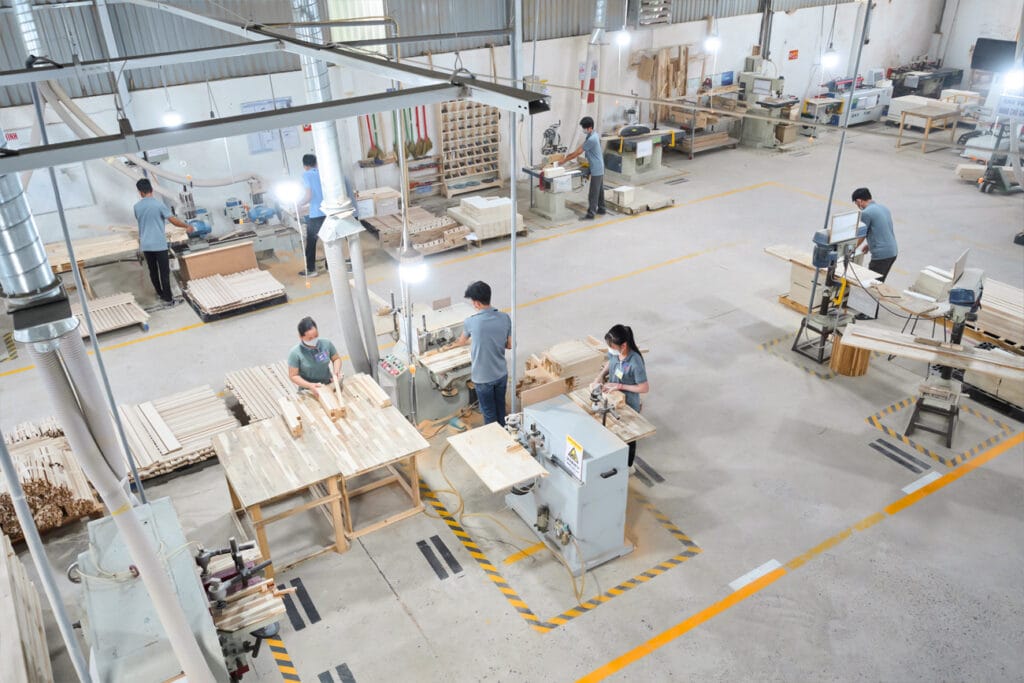
Choosing a wood furniture manufacturer in Vietnam should not come down to finding the lowest quotation.
For UK buyers, the stronger sourcing process is to evaluate the complete path from product specification and materials to engineering, prototype approval, quality control, packaging, documentation, and mass production.
A clear process reduces ambiguity between the buyer and factory and makes it easier to identify potential issues before they reach a full production order.
With over 10 years of manufacturing experience, IMITI supports international B2B buyers with wooden bedroom furniture, wooden living room furniture, and custom OEM/ODM furniture manufacturing in Vietnam.
Whether your project starts with complete technical drawings or only an initial furniture concept, our team can support the development process toward a clearer, production-ready product.
Looking for a wood furniture manufacturer in Vietnam for your UK furniture program?
Contact IMITI to discuss your product specifications, reference images, materials, target quantity, and sourcing requirements.
Recent Comments